What is forest camouflage?
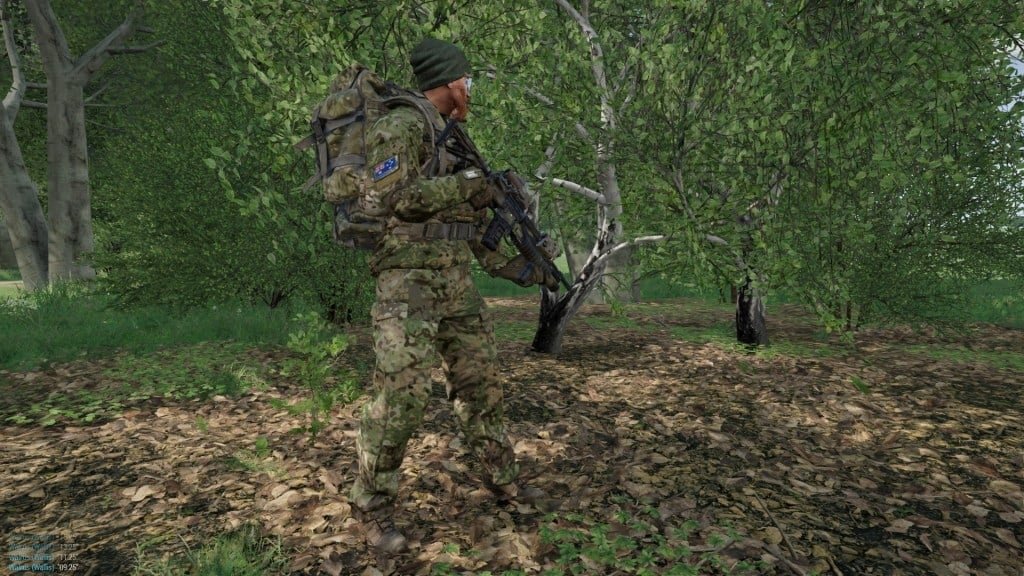
Forest camouflage is the family of patterns built for temperate woodland: the mixed forest, undergrowth, bark and dappled light of Europe, North America and northern Asia. The job is to break up the human outline so it scatters into the visual noise of the trees. Three things do the work. Disruptive shapes destroy clean edges, a balance of green and brown matches both foliage and bark, and contrast tuned to mid-range distance keeps you broken up where it counts. Unlike jungle patterns, forest camo leans on brown and shadow as much as green, because temperate woodland is rarely green all the way through.

What does forest camo look like? Colors and shapes
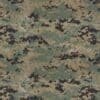
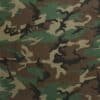
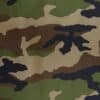
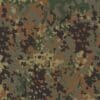
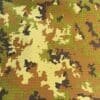
The palette balances green and brown, backed by black for shadow and tan or sand for highlights. Green ties you to the foliage, brown to trunks and leaf litter, black to the deep gaps between the trees. Shapes range from the bold blotches of M81 Woodland and the long strokes of DPM to the dense dots of Flecktarn and the pixels of MARPAT and EMR. The denser and shadier the forest, the more a pattern leans on darker greens and browns. Open, sunlit woodland rewards a bit more contrast and lighter tone.
How to choose the best forest camo pattern
There’s no single best forest camo. The right one matches your specific woodland first, then your mission. A deciduous hardwood forest, a dark pine or boreal stand, and an open mixed wood all read differently to the eye.
By forest type
| Forest type | What to look for | Patterns that fit |
|---|
| Dense deciduous / hardwood | Strong green, mid-range break-up | M81 Woodland, MARPAT, Flecktarn, Partizan |
| Pine / boreal (dark, shaded) | Darker greens and browns, deep shadow | MARPAT, Flecktarn, PenCott GreenZone |
| Open / mixed woodland | Balanced green-brown, lighter tone | CCE, DPM, A-TACS FG, EMR |
| Birch / bright broken light | High contrast, leaf-like shapes | Berezka, Izlom |
| Green-season / heavy foliage | Lush greens, dense pattern | PenCott GreenZone, Kryptek Mandrake |
By mission and season
Forest changes with the seasons, so the pattern that hides you in July can stand out in November. Summer foliage favors green-heavy patterns, while autumn and bare-branch woodland reward more brown and tan. On the move, bold shapes like Woodland or Izlom mask motion well. Holding a position, an organic pattern like A-TACS FG or Mandrake settles into the backdrop. Match the tone to the light too, since very dark patterns flatten out in open sun.
Forest camo vs woodland camo: what’s the difference?
People use the two almost interchangeably, and that’s mostly fair. “Woodland” usually points to a specific lineage, above all the US M81 Woodland and its four-color descendants. “Forest camo” is the broader umbrella for any pattern built for temperate woodland, from M81 to Flecktarn, DPM, MARPAT and the Russian designs. Put simply, all woodland patterns are forest camo, but not every forest pattern is “Woodland.”
When was forest camouflage first used?
Disruptive woodland patterns trace back to World War II, but the modern era really starts with the US M81 Woodland in 1981, derived from the earlier ERDL pattern. Europe ran its own lines in parallel, from British DPM to German Flecktarn and French CCE, while digital designs like MARPAT and Russia’s EMR brought the pixel approach to the forest from the 2000s onward.